
Mother 1 + 2 (MOTHER 1 + 2 Mazā Wan-Tsū) is a console role-playing game developed by Ape Inc., Nintendo Tokyo R&D Products and HAL Laboratory and published by Nintendo for the Game Boy Advance on June 20, 2003. It is a compilation of the first two installments of the Mother series, MOTHER and MOTHER 2: GIYGAS STRIKES BACK! (known outside Japan as EarthBound Beginnings and EarthBound, respectively). The game was meant to promote the upcoming Mother 3 (also for the Game Boy Advance as the rebirth of the franchise, and it has currently been released only in Japan). As it features two different games, its developer credits vary, but between both Mother and Mother 2, Shigesato Itoi acted as the designer and director, and music was composed by Keiichi Suzuki and Hirokazu Tanaka. Mother tells the story of Ninten, a 12-year-old boy who journeys around the world using his psychic powers to collect eight melodies in order to save the planet from an evil race of mind-controlling aliens. Mother 2 tells the story of Ness, a young boy who journeys around the world also using psychic powers to collect eight melodies in order to save the future from an alien of pure evil, intending to sentence all of reality to the horror of eternal darkness.
Tomato has released a hack for the Mother portion of the game to be fully translated, removing all censorship, retaining the original text, and including an optional "Easy Ring" that doubles the experience and prize money earned from battles. According to him, the latter addition was done to provide fans with an easier way to get into the game by reducing its infamously high level of difficulty and the amount of grinding required to overcome it, the latter of which Tomato described as making Mother feel more like a chore. Meanwhile the EarthBound portion of the game simply has the menu commands and names translated. Following Mother's official international release as EarthBound Beginnings, however, he has stated on Twitter that "I absolutely prefer that people play and support the official release and not my silly little hobby project." This action goes in line with the main condition of the Unofficial Mother 3 Fan Translation, which is intended to be shut down by its staff should Mother 3 receive an official international release. In 2015 "Jeffman" had begun development of a hack translating the EarthBound portion of the game in English making both the Mother 1 and Mother 2 sides of the game Unofficially English translated.
Development[]
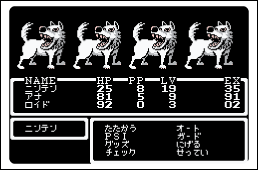

Ninten and his friends fight a pack of wolves in Mother
Mother was designed and directed by Japanese copywriter and television personality Shigesato Itoi. The game was named after John Lennon's song "Mother". Originally, the last parts of the game were not tested for bugs and balance issues. This issue was corrected for the Mother 1 + 2 release.
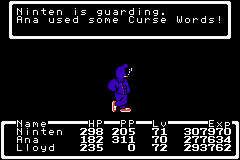

Ninten and co. fighting a B.B. Gang Member in the fan translation of the Mother portion.
Development on Mother 2 took place as a joint effort between Ape, Inc. and HAL Laboratory, Inc. and was again designed by Shigesato Itoi. The total development time for the project was five years, much longer than was initially expected. Because two companies were working on Mother 2, responsibilities were spread out between the two studios. Ape had more people working on the title and oversaw the data aspects of the game while HAL worked on the programming. Because the two studios were based at separate locations, employees would regularly have to travel between the studios to work.
A direct sequel to Mother 2 for the Nintendo 64 would later enter the development stages, where it remained for many years before being canceled on August 21, 2000. Three years later, the project began being reworked into a third installment, Mother 3. Around this time, the first two titles received improvements for their forthcoming re-release on the Game Boy Advance, to promote Mother 3.
Released on June 20, 2003 by Nintendo, a bonus cell-phone strap of Mr. Saturn was included for pre-ordered packages of the game. Though the strap was originally intended only for those who had pre-ordered the game, its popularity caused it to be sold briefly on Amazon in Japan. A cost-reduced version of the game was later released for around 2,600 yen, which was packaged with a Club Nintendo serial card. Mother 1 + 2 sold over 250,000 copies, and the reduced-value version has sold an additional 60,000 copies.
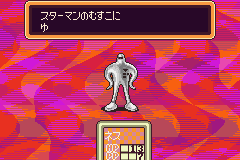

Ness fights Starman Jr in Mother 2
Though the port was only released in Japan, the versions of Mother and Mother 2 included in Mother 1 + 2 are actually re-translations of the English versions of the games even though, somewhat ironically, Mother never had a proper English release. The name of the company that directed the port and re-translation has never been announced by Nintendo.
Marketing[]
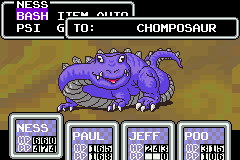

Ness and co. battling a Chomposaurus in the partially translated EarthBound portion.
Though the concept of Mother 1 + 2 was to compile two separate games into one easily accessible package, promotion focused entirely on Mother 2 (known in North America as EarthBound), much to the dismay of long-time fans, who argued that the promotional strategy was reducing the importance of the first game.
Differences from Mother and Mother 2[]
Numerous changes from the original versions were incorporated into Mother 1 + 2. Changes in Mother related to in-game events, graphics and items are mostly identical to the changes made in EarthBound Beginnings. Two obvious differences in both games are that everything seems zoomed in and sounds have been changed due to the Game Boy Advance's screen and sound limitations (the sound difference is more obvious in the Mother 2 portion, where the audio quality is noticeably worse due to the GBA's audio compression). Plus, the lighting is also much brighter, to compensate for the GBA's lack of a backlight.
MOTHER[]
Most of the changes in this port reflect those found in the NES prototype, EARTH BOUND. This seems to clarify that the prototype cartridge found was legitimate, and these changes were likely put in to make the game more available to a broader audience. This is most likely due to the Computer Entertainment Rating Organization (CERO) being founded in Japan a year before the release of MOTHER 1+2; the Famicom version contained its more mature content due to the nonexistence of a software rating board at the time of its development and release, and the changes in EARTH BOUND were made due to Nintendo of America marketing their products as toys to appeal to a broad audience. Since there was already a censored ROM of MOTHER during the development of MOTHER 1+2, it would've been easier to simply implement said ROM into the multicart for the sake of convenience.
- The screen animates when Ninten and co. learn a melody, like in EARTH BOUND. However, the animated lines are thick, wavy and move diagonally downwards, from side to side. In EARTH BOUND, the animated lines are thin, straight, and move straight down, and in a choppier motion as well.
- The order that each PSI power is learned has been changed.
- Ninten's father does not say to hold reset when the game is being shut off. The GBA does not require this, so this was taken out. Likewise, the Ultimate Machine (which simply tells the player how to shut off the game) has its dialogue changed to "Just turn the power off!"
- The L-button on the GBA now serves as a shortcut feature, automatically inputting the "Check" command, or "Talk" if facing an NPC, like in the SNES version of EarthBound
- The game can be put into Sleep Mode, like most GBA games.
- The characters no longer walk in single-tile increments; movement is more fluid like in EarthBound and MOTHER 3.
- Ninten and co. can run with the R button. However, unlike EARTH BOUND, running no longer runs the game at double speed, and instead functions like the run feature in other games such as Super Mario Bros.
- There is a mosaic effect when Ninten and friends enter a battle, in place of the double-iris effect.
- The present in Ninten's basement containing the Map now contains a loaf of bread; the Map is now accessible at any time by pressing START.
- The in-game text's speed can be changed, via the new "Settings" option.
- Checking an enemy now also results in a 1-line comment about the enemy, like in EARTH BOUND.
- SMAAASH!! is always displayed in green with a white outline. In the NES and Famicom versions, it was white, with an outline whose color depended on the enemy.
- The enemy and party member attack sounds are swapped, like in EARTH BOUND, since they were incorrectly attributed in the Famicom version.
- The text itself changes color when statuses do. The color around the text used to change, while the text itself would remain the same color.
- Enemy encounter rates seem to be much higher and similar to the encounter rates in Pokémon. The bug where opening the menu resets the number of steps taken before a random encounter is fixed.
- The strip club that Mr. Duncan plans to build in Merrysville is changed to a different kind of shop.
- The "Repel Ring", which lowers the rate of random encounters, has been added, and can be bought from one of the shops in Magicant.
- The Dragon Quest IV (Dragon Warrior) reference (Super Mario Bros. 7 in the prototype) in Twinkle Elementary School is replaced with "that game".
- Using "Check" in the field will tell Ninten and co. if they can be attacked or not. This is useful, since it is not always clear where town boundaries end.
- Other changes that were made between Mother and EarthBound Beginnings can be seen, such as
- Crosses were replaced with simple gravestones, etc.*
- The crows don't have cigarettes.*
- The Shroudley has no blood dripping from its hands.*
- The Gang Zombie/Nasty Zombies don't have blood, but instead have ties.*
- The Bla Bla Gang's leader has no knife.*
- Dr. Distorto has no blood on his coat.*
- The healer restores the party's HP.
- Magicant's underground path and the path leading to Mt. Itoi have been simplified, to ease navigation. Halloween also has its layout altered to appear more streamlined.
- The helpful old man in Queen Mary's Fountain changes duties from a healer to an ATM.
- The non-functioning Friendship Ring is removed from the game's coding.
- Enemies now appear in tunnels.
- Most of these changes have been made to remove any graphic content that would perhaps stir controversy.
- Changes marked with an astertisk ("*") are reversed in Tomato's fan translation.
- Ana is put into character slot #2, moving Lloyd (who was there first) to slot #3.
- Teleportation time is slightly longer (due to the change in the motion system), but the speed is a little slower to make it easier.
- The screen scrolls when the party is sucked into the whirlpool, a change possibly made because of the Game Boy Advance's limited screen size.
- A short scene showing everyone escaping from EVE's factory was added. It is simply a reversed version of the above cutscene, but with EVE added to the party.
- After obtaining EVE's melody, Ninten and friends also get a "Memory Chip", which will instantly take the party back to EVE; this decreases the difficulty of Mt. Itoi by preventing the need to climb the mountain again if they leave.
- The bug that allows the Flea Bag to work on enemies like R7038 is fixed.
- The Bread Crumb glitch, which was commonly abused for speedruns of the Famicom version, is fixed.
- The circumstances surrounding the eighth melody are heavily altered. In the Famicom version, the party is warped to Magicant immediately after obtaining the seventh melody. Despite not completing the song, they sing it to Queen Mary, who remembers the rest of the song on her own. The GBA version follows the variation from EARTH BOUND, where the eighth melody is learned from George's gravestone atop Mt. Itoi, and upon going to Magicant, the party is able to relay the full song to Queen Mary.
- Ninten and friends are instantly warped to Magicant after obtaining the 8th melody, instead of having to arrive there on their own as in EARTH BOUND.
- The philosopher's song is a Japanese translation of what he says in Earth Bound Zero.
- During the final battle, "Run" is replaced by "Sing" following Giygas's monologue. The blank spot was taken by "Settings", so something had to be replaced.
- An extra area was added right before the final battle. This area is a small hallway leading to Gyiyg, but there is also a room to the right. In this room, Ana finds numerous people trapped in various pods (similarly to the second-to-last room of the Stonehenge Base). One person recognizes Ana from her hat, and explains that her mother is among them, yet can only be freed through Gyiyg's defeat. In the Famicom version, the door that would lead to the hallway simply takes the player to the summit, where Gyiyg is fought.
- Note that the prison room was also present in the Famicom version, but was located at a much lower spot (where they could access it even while carrying EVE with them). It is unknown why the room was relocated.
- The ending is completely different. It is the same as the ending of EARTH BOUND. Just like the prototype ending, it does not change depending on Ninten's final party and assumes the party went the default route.
- Despite being based on the NES prototype, there is no credit to Phil Sandhop or the localization team for EARTH BOUND.
- The theme used in the credits is "The Paradise Line", used for the train rides, instead of the plane ride theme.
- Tomato's fan translation adds a present in Ninten's room containing a new item called the "Easy Ring", which doubles the amount of experience and money earned from battles and reduces the rate of random encounters. This was done to minimize periods of grinding and make the game feel less like a "chore."
Mother 2 (EarthBound)[]
- The Rock candy and Condiment glitch has been fixed.
- In Burglin Park, a person talks about flies landing on the food and making it tastier. The text here was altered slightly in the GBA version to make the flies' landing seem unintentional.
- For some odd reason, the characters for the names are reduced from 6 to 4, and 5 characters can be used to name Ness's dog. This is probably because Japanese games do not normally use romaji to write names or text.
- The Exit Mouse cannot be used in the Cave of the Past, which was a bug in the Super Famicom version that was apparently fixed in the SNES version. However, the Exit Mouse can be used in the Devil's Machine, a glitch new to the game.
- The Shattered Men in the Summers Museum disappear after Giygas is beaten, which did not occur in Mother 2 and EarthBound, and would crash the game if the Shattered Men were to defeat Ness's team.
- There is a poison-related glitch which allows Gyiyg to be beaten without praying, a glitch new to this version.
- Jeff can get SMAAASH!! attacks with his guns.
- Almost every scene has scrolling effects due to the Game Boy Advance's screen size.
- The glitch in the Zombie Relief Corps's tent has been fixed.
Reception[]
Mother 1 + 2 was given a total score of 35 out of 40 by a panel of four reviewers for Famitsu Although the compilation was not released in North America, Nintendo Power magazine listed Mother 1 + 2 as the most-wanted import game in a 2005 issue.
Sales[]
By the end of 2003, Mother 1 + 2 had sold over 278,000 copies.[1]
Music[]
- Main article: Mother 1 + 2 (soundtrack)
Mother 1 + 2's soundtrack was was composed by Keiichi Suzuki and Hirokazu Tanaka. It was released on compact disc in 2003. It consists of different arrangements of the original songs, but its title mislead some purchasers into believing that it was a re-release of the original Mother soundtrack. The soundtrack contained low quality of the arrangements (a direct result of the GBA's inferior audio compression in comparison to the SNES, also seen in other GBA ports of SNES titles), and the fact that the CD jacket contained numerous errors concerning the song titles. However, its release led to renewed calls for the re-release of the Mother soundtrack, and a "re-mastered version" of the Mother soundtrack followed on February 18, 2004.
Suzuki has cited John Lennon as an influential figure to the composers, when composing the original songs from both games.
Advertisement[]
Mother 1 + 2 was advertised with four commercials, most of which involve the sprites and names of characters, followed by footage of both games as played on Mother 1 + 2 with a voiceover saying "Weird games or moving RPGs?" followed by the title. Every advert humorously ended with a Mr. Saturn.
External links[]
Videos[]

References[]
- ↑ Template:Cite web